Sunday, August 22, 2010

St. Helena Post Office


Lewis Simon was the architect on this remarkably intact Post office building from 1940 in St. Helena. This charming town has managed to be respectful of most of its architecural heritage. Unlike many towns that have decimated their historic downtown area, like Palm Springs to name but one, St. Helena seems to be thriving. I can't help but wonder if there is a lesson to be learned here.....
I'll post more pix of the St. Helena trip soon...

Friday, July 30, 2010

Endangered Building No. 7: WWII Barracks


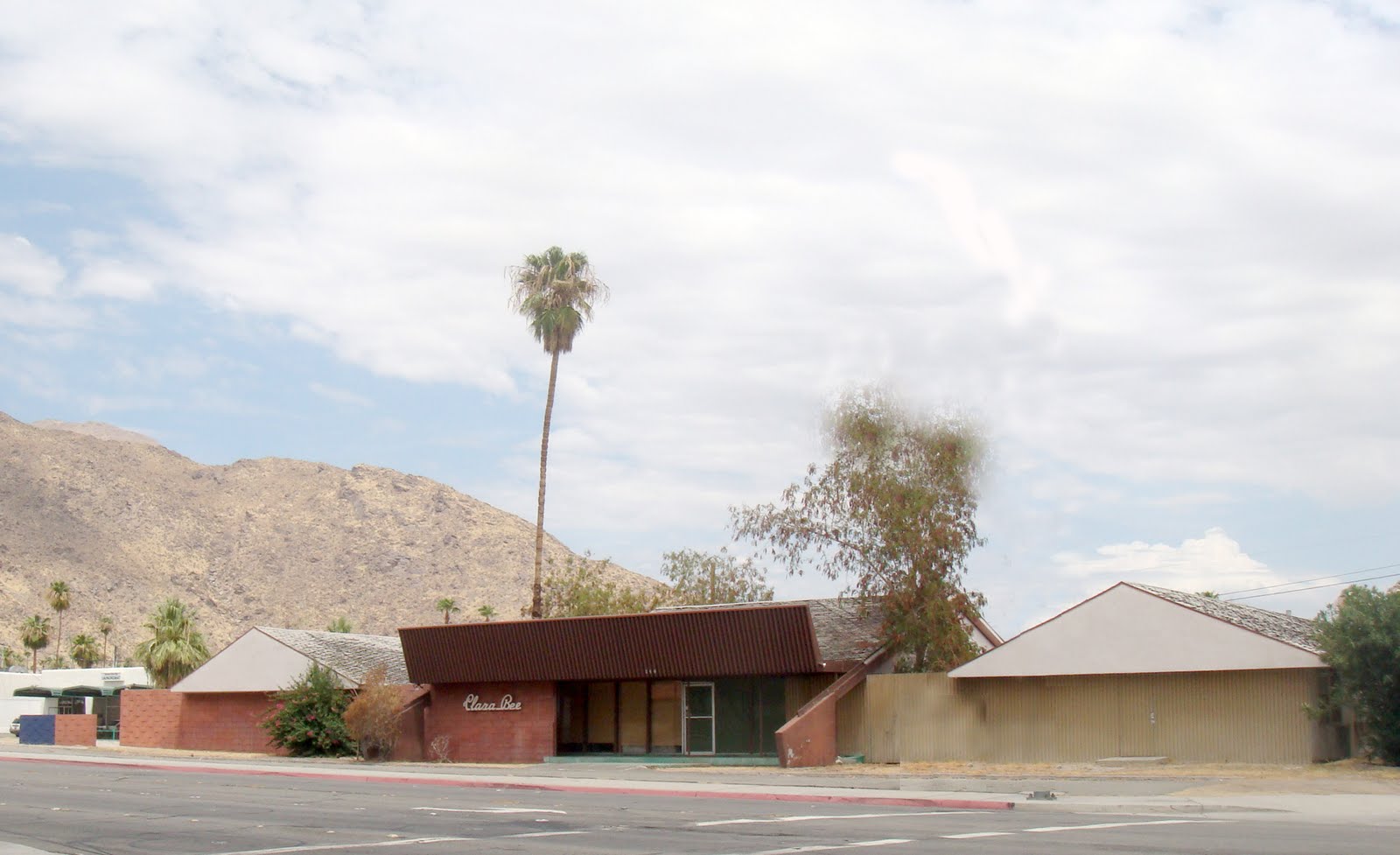
When the US entered WWII, the Air Force ferrying Command came to the desert and built these barracks. The City built the road on land donated by Pearl McManus, and in exchange it was named “McCallum Way”, to honor her father. Later, it was renamed Tahquitz-McCallum Way. Later still it was renamed again, dropping “McCallum” for today’s “Tahquitz Canyon Way.” It would appear that Palm Springs has little use for its history....After the war, the barracks were sold and individually moved to locations throughout the desert, Among the most prominent of these hearty survivors is the Clara Bee on Ramon Road. It was altered by architects Wexler & Harrison for use, originally for retired army nurses, I am told, and later it became a Women’s Shelter. It is located on Indian land and today is vacant and scheduled for eventual demolition.

There are those who say that the preservation community wants to preserve “every old building” so I offer the Clara Bee as an example of an old building that does not necessarily warrant preservation....but it might be interesting to see if the Wexler & Harrison facade could be incorporated into a new building on this site......


Sunday, July 25, 2010

Endangered Building No. 6


Back in 2007, the Historic Site Preservation Board (HSPB) considered the nomination as a Class 1 Historic Site the "Casa de Rancho" a Morongo Street compound built in the 1940s for Dr. William Scholl. He was the inventor of those famous foot treatment products that are a staple to the retirement-age citizenry of Palm Springs. Dr Scholl might have joined the ranks of the town’s prominent (part-time) residents to be honored by the designation, but it was not to be. When built, the Spanish Colonial style property was a mini-estate containing ten buildable lots; such parcels are extremely rare in Palm Springs today. Struggling with the concepts of Setting and Context, the HSPB lost its courage and recommended protecting only the main house, which was centered on two lots facing Morongo; the remainder of the fully landscaped site which contained a swimming pool and pool house, tennis courts and gardens was not included in the recommendation to the City Council. Predictably, the owner opposed the designation, and, while owner consent is not required by the designating ordinance, the City Council deferred to the owner’s wishes and declined the recommendation, resulting in a property that had no protection. With the City’s failure to protect the property, the owner immediately walled off the main house, demolished the outbuildings, filled in the pool, stripped the mature landscape and prepared to sell off the lots for development.

Needless to say, the owner did not predict the global financial melt-down that subsequently occurred, and the empty lots remain undeveloped and available. The appearance of the property today is that of a forlorn, blighted site, littered with unfinished construction debris; it retains little of its original charm or value, an impact on the neighborhood that will not be easily overcome. Among the lessons to be learned here is the understanding of the value to an historic property of its setting and historic landscape. As these few surviving larger parcels start being subdivided, the character of the neighborhoods, and ultimately the town itself will be diminished….


Wednesday, July 7, 2010

Endangered Building No. 5


This is another local building that appears to be endangered; it is the Charthouse Restaurant designed by architect Kendrick Kellogg, one of the most gifted architects to work in the Coachella valley. The 1978 building is located at 69-934 Highway 111, and was designated as an historic resource in Rancho Mirage in 2004. Owned by Palm Springs’s maverick developer John Wessman (see endangered builing No. 3), it has been sitting empty for many months and based upon the current appearance of the site, with its dead grass and dying landscape, has had its water turned off for some time. This is yet another example of demolition by neglect, and in its current state is definitely a fire hazard.

The building was designed to reflect the curving forms of the natural site; the hill appears to slope down through the restaurant. In 1994 it received an award sponsored by AIA of the Inland Empire of California, who noted that the building was energy efficient before the concept of energy efficiency became popular. The roof, with four inches of urethane foam, undulates around the perimeter of the small hill resting on recycled roof boards which are supported by laminated curved beams. The centered skylight is made of 3 layers of translucent plastic running the full length of the restaurant. The undulating rock walls are from the site. The double doors at the entrance are made of laminated beveled glass in fine curved wood frames, for keeping out the 130 degree summer heat. A low-profile twenty foot long waterfall runs through the glass near the entrance. In 1981 the restaurant was on the cover of Restaurant Design Magazine. To paraphrase a corporate officer of Charthouse, "To change Kellogg's design is to jeopardize our investment."

Kellogg attended the University at San Diego State, University of Colorado, University of Southern California, and the University of California at Berkeley. He received his architect’s license in California in 1964. Kellogg’s motto is, "the more unusual the site, the better the Architecture." Kellogg’s work features totally unified concepts of organic architecture that were inspired by Frank Lloyd Wright and Bruce Goff. His is a rather unorthodox philosophy regarding architecture and the profession: Although architectural school taught basic engineering, it also inadvertently taught Kellogg what not to do. He feels that “Architecture cannot be taught. Beauty comes from within….A license does not make Architecture. Competitions are, for the most part, political. The technology of any time is only a tool.” Kellogg believes “Organic Architecture is the Mother of the Arts. Beauty is the sustainable essence of life. Nature is not sentimental. Both beauty and nature are the practical aspects of our compassion for survival.”


Thursday, June 24, 2010

No. 4 on the Most Endangered List


Actually, I'm a little late on this one....somebody had the bright idea to remove the historic Cypress Trees along the Welwood Murry Cemetery wall. The cemetery was established in 1894, and these trees likely date from then. Although I love Palm Trees as much as the next guy, in this installation they resemble nothing so much as telephone poles. This seems like an outrageous, unneccessary and misguided improvement. Although technically the trees are on public land, the Cemetery itself is a Class 1 Historic Site, changes to which require review by the Historic Site Preservation Board, a civic entity that has consistently had its head up its ass lately...but you'd think somebody might at least check in with them before changing another property associated with the pioneering Murray family (See endangered Building No. 1). Another example of the importance of historic landscape...lost.


And so I rant on......


Palm Springs Most Endangered Buildings, No 3


DEMOLITION BY NEGLECT

Many people have tired of hearing about The Center - a.k.a. Town & Country Center, (1947, A. Quincy Jones and Paul R. Williams). A few months ago this historically significant building wound its way through the city designation process, with protection as a Class 1 site ultimately denied...in spite of being eminently qualified. Such are politics in a small town. Recently Zeldaz dance club, the Center’s last major tenant, gave up the ghost after 30 years and relocated to the Sun Center (1965, Richard Harrison) on South Palm Canyon. This is interesting for a number of reasons.

If the owner of The Center had maintained the building, Zeldaz, and any number of other tenants might still occupy this and other downtown buildings. Instead, Zeldaz became just another tenant who felt the need to abandon the downtown area surrounding the vacant and moribund Desert Fashion Plaza.

On the other hand, sensing the deterioration of the central downtown core, the owners of the Sun Center recently invested in the rehabilitation of their property which now appears to be flourishing. Can’t help but think the same thing might have happened to The Center, if its owner were not so interested in its demolition. As most preservationists know, there’s almost nothing worse that can happen to historic buildings than for them to sit empty for long periods of time. Their systems begin to fail, and the restoration costs begin to climb. Unsympathetic property owners of historic buildings are well aware of this phenomenon, and the choice to neglect and vacate these buildings is often a prelude to demolition, hence the term “Demolition By Neglect”

There is a touch of irony in the Zeldaz relocation. In the past, when “straight” neighborhoods or clubs get rundown, urban myths would have it that they are rediscovered by gay men who polish their tatty charms with sweat equity and recreate them as gay neighborhoods (Christopher Street and the Castro, to name but two) or clubs. In this case, the irony is that Zeldaz took over the space of a gay night club and seems to be making a go of it. Good for them. I can’t help but wonder if its time for a gay entrepreneur to take over the old Zeldaz space and make it into something fabulous, like maybe recreating the original Town & Country Restaurant!

Interesting footnote: In 1970, when Max Palevsky was building his great Craig Ellwood-designed desert home, he stayed in one of the very high-styled apartments at The Center.

Friday, June 4, 2010

#2 on Palm Springs Most Endangered List


In the heyday of unbrideled real estate development that was Palm Springs before the golbal financial meltdown, this remarkable building complex was deemed expendable by local decision-makers. The site was "needed" to develop East Tahquitz Canyon Way into an upscale hotel zone, so arrangements were made to relocate the tenents of these buildings as a prelude to their demolition. Essentially "saved" by the bad market...they survive at least temporarily, until the economy revives.

In a town that loves Modernism, designs that show the influence of Pueblo Architecture are often discredited. Oddly, early modernists such as Irving Gill and Albert Frey paid homage to the style of this continent's oldest structures, but somehow, when Hugh Kaptur does the same thing, he gets no respect. Go figure...

So, while time allows, do yourself a favor and pay a visit to these singularly important and beautiful buildings. You'll thank me later...